

A genetic profile (DNA profile) is a fixed set of DNA markers that uniquely identifies an individual and never changes. It’s used to confirm identity, verify parentage and family relationships, and support responsible breeding.
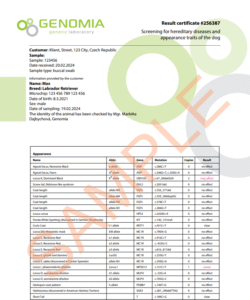
Genetic profile
A genetic profile, sometimes referred to as a DNA profile, is a set of genetic markers that uniquely identifies an individual. A genetic marker is a specific part of the DNA code that varies between individuals.
A genetic profile remains unchanged throughout life and cannot be falsified or destroyed. It is used to identify an individual, verify parentage and relationships, and support responsible breeding.
—
Genetic profiling possibilities
Genetic profiling serves as a reliable lifelong identification method in many situations:
Identification
– In case of loss or theft of a dog – The identity of a recovered individual can be confirmed.
– In the event of a malfunctioning microchip – If the chip stops working, the dog’s identity can still be proven.
– During insemination – Used for semen identification.
Parentage verification
– Routine pedigree checks or uncertainty of parentage – Confirms paternity or maternity after intentional or accidental mating or after insemination.
– Double mating – When a breed allows double mating, the mother, all puppies, and both sires must have DNA profiles so parentage can be confirmed.
– “Clear by parents” verification – If both parents test negative for a recessive disorder, the offspring can be declared “clear by parents,” provided that parentage is confirmed by DNA profile. This is recommended every second generation.
– Other family relationships – If parents cannot be verified, other relationships such as siblings, grandparent–grandchild, or uncle–nephew can be assessed. Including more related individuals increases accuracy.
Breeding applications
– Selecting the optimal breeding pair – Comparing DNA profiles helps select combinations that maintain genetic diversity. It is desirable for breeding pairs to be as heterozygous as possible in the compared traits.
– Population studies – Monitoring genetic diversity, heterozygosity, and inbreeding.
—
Sample collection
For genetic profile testing, buccal swab samples are used.
The swab must be carefully collected by rubbing the inside of the dog’s cheek and stored in a breathable container to ensure proper drying.
A well-collected and well-stored swab provides excellent DNA quality for all analyses.
—
Methodology
Perro Genetics works with an accredited laboratory that uses internationally recognised ISAG (International Society for Animal Genetics) standards and participates regularly in ISAG quality comparisons, consistently achieving the highest quality results.
There are two main technological approaches to DNA profiling: STR and SNP.
These systems are not compatible with each other and cannot be directly compared.
—
SNP genetic profile (ISAG2020)
SNP (Single Nucleotide Polymorphism) profiling analyses single-base DNA variations. These markers are highly stable and follow Mendelian inheritance, ensuring excellent reliability and robust genetic identification.
SNP profiles are ideal for population studies because they include many markers evenly distributed across all chromosomes, providing complete genomic coverage for evaluating diversity and heterozygosity.
SNP analysis steps
– DNA isolation – High-quality DNA is extracted from the sample.
– Massively Parallel Sequencing (MPS/NGS) – Hundreds to thousands of SNP markers are analysed simultaneously using advanced sequencing technology.
– SNP marker identification – ISAG2020 Panels 1 and 2 standardise 231 SNP markers. The laboratory reports a minimum of 218 analysed markers.
– Bioinformatics analysis – After sequencing, software determines the genotype based on specific SNP variants. Each SNP has “two letters,” one inherited from each parent.
Benefits of SNP profiling
– Higher accuracy – Many markers across all chromosomes allow precise identification.
– Higher marker stability – Very low mutation rate (approx. 1 mutation per 100 million bases per generation).
– High throughput – Hundreds of samples analysed at once.
– Ideal for population studies – Monitoring inbreeding, genetic diversity, homozygosity/heterozygosity.
Disadvantages
– Longer processing time.
—
STR genetic profile (ISAG2006)
STR (Short Tandem Repeats) profiling analyses microsatellite markers—short repeated DNA sequences of two to seven base pairs.
The number of repeats is inherited from each parent, making STR profiles an excellent tool for parentage verification and individual identification.
STR analysis steps
– DNA isolation – Extracting DNA from the sample.
– PCR amplification – STR markers are amplified using specific fluorescently labelled primers.
– Fragment separation via electrophoresis – Amplified fragments are separated by size.
– Detection and data analysis – A laser scanner detects fluorescent fragments and records the length of each STR marker.
– Interpretation of results – Each marker contains one value inherited from the mother and one from the father, enabling identity or relationship confirmation with >99.99% accuracy.
Markers included in the ISAG2006 panel
AHTk211, CXX279, REN169O18, INU055, REN54P11, INRA21, AHT137, REN169D01, AHTh260, AHTk253, INU005, INU030, Amelogenin, FH2848, AHT121, REN162C04, AHTh171, REN247M23, AHTH130, REN105L03, REN64E19.
The partner laboratory reports at least 19 markers.




Reviews
There are no reviews yet.