
PRA-prcd is a retinal disease caused by the c.5G>A mutation in the PRCD gene. It gradually destroys rod and cone cells, starting with night blindness and often leading to total vision loss in adulthood. Genetic testing identifies affected or carrier dogs and supports informed breeding, but annual eye exams are still recommended since other retinal mutations may exist.
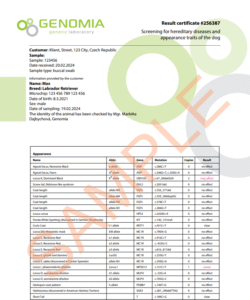
Testing performed in cooperation with our partner laboratory.
The progressive rod–cone degeneration (PRA-prcd) is caused by the c.5G>A mutation in the PRCD gene (formerly designated as 1298G>A).
The PRCD gene affects mainly the retina, with expression in the retinal pigment epithelium, photoreceptor cells, and ganglion cells.
This mutation leads to an exchange of the nucleon TGC basis for TAC, resulting in the binding of a different amino acid and causing structural and functional changes in the resulting protein.
This genetic disorder causes the rods and cones (the photosensitive cells of the retina) to gradually deteriorate and die.
The onset of the disease is typically in adolescence or early adulthood, although the exact age of onset and severity vary by breed.
Affected dogs first lose rod-cell function, leading to night blindness. Over time, cone degeneration follows, and the condition progresses to complete blindness.
Genetic testing helps clarify the diagnosis.
It determines the dog’s genotype and is the primary tool for reducing or eliminating PRA-prcd occurrence within a breed.
However, it is important to be aware that:
Not all retinal diseases belong to the PRA-prcd group.
There are multiple causes of PRA across different breeds.
In some breeds, more than one mutation may be responsible for retinal atrophy.
For this reason, annual ophthalmologic examinations by a certified veterinary eye specialist are recommended.




Reviews
There are no reviews yet.