
Hyperuricosuria is caused by the SLC2A9 gene mutation (c.656G>T), which leads to excess uric acid in the urine and increases the risk of crystal and stone formation. Dogs that inherit two mutated copies are affected; carriers usually show no symptoms but can pass the mutation on.
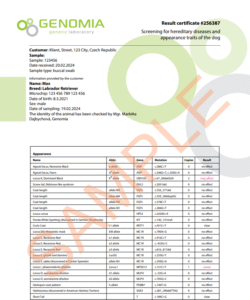
Testing performed in cooperation with our accredited partner laboratory.
Hyperuricosuria is a metabolic disorder characterised by excessive excretion of uric acid into the urine, which can lead to the formation of uric acid stones.
Allantoin is the final product of purine metabolism in all mammals except humans, great apes, and Dalmatians.
In most dog breeds, uric acid is converted into allantoin.
However, Dalmatians lack this metabolic conversion, causing uric acid levels in their blood and urine to be significantly higher.
In dogs with normal metabolism, uric acid is filtered in the glomeruli and reabsorbed in the proximal tubules, where it re-enters the bloodstream.
During evolution, humans, apes, and Dalmatians all developed a mutation affecting this urate transport mechanism, resulting in higher uric acid excretion.
This mutation increases susceptibility to uric acid crystals and urinary stones.
The Dalmatian breed is particularly affected because:
1. A mutation responsible for white coat colour (MITF gene)
2. A dominant ticking/spotted coat pattern mutation (T-locus)
3. A mutation influencing spot size
—all became genetically linked to the same region where the HUU mutation occurs.
This caused the mutation responsible for hyperuricosuria to spread throughout the entire breed.
Because all purebred Dalmatians were homozygous for this metabolic defect, a backcross breeding programme was started in the USA in 1973.
Robert Schaible crossed a Dalmatian with a Pointer, and after several generations of selection, dogs with low uric acid levels (LUA Dalmatians) were produced.
These LUA dogs were later accepted by the AKC and other kennel clubs, and today they are recognised and registered as purebred Dalmatians.
Many breeders continue to support this programme.
Recently, DNA testing has become available to directly identify the mutation responsible for high uric acid.
Hyperuricosuria in dogs is associated with the SLC2A9 gene mutation, specifically c.656G>T (p.C188F).
Dogs that inherit two mutated alleles (homozygous) are affected and may suffer from urinary stones.
Dogs with one mutated allele (carriers) may not develop symptoms but can pass the mutation to offspring.
Breeds with a small gene pool, or with certain coat colour modifications linked to the same region, may be more susceptible.
The SLC2A9 mutation has been identified in numerous breeds, including Bulldogs, Black Russian Terriers, American Staffordshire Terriers, Retrievers, Poodles, Boerboels, Weimaraners, German Shepherds and others.
For some breeds, such as the Dalmatian (except LUA lines), all individuals are homozygous affected.
—
References
Karmi, D. et al. Frequency of the Canine Hyperuricosuria Mutation in Different Dog Breeds. J Vet Intern Med 2010.
Karlsson EK et al. Efficient mapping of Mendelian traits in dogs. Nat Genet 2007.
Little C. The Inheritance of Coat Colour in Dogs. 1957.
Schaible R. (1976) Linkage of a pigmentary trait with uric acid excretion.
Schaible RH. Genetic predisposition to uroliths in Dalmatians. Veterinary Clinics of North America.
Bannasch D. et al. Mutations in the SLC2A9 Gene Cause Hyperuricosuria and Hyperuricemia in the Dog. PLoS Genet 2008.
Reviews
There are no reviews yet.