
PLL is an inherited eye disorder where the lens slips from its normal position because the supporting fibres weaken. It can cause sudden pain, glaucoma, and permanent vision loss. The condition is strongly linked to terrier breeds and is caused by a mutation in the ADAMTS17 gene (c.1473+1G>A).
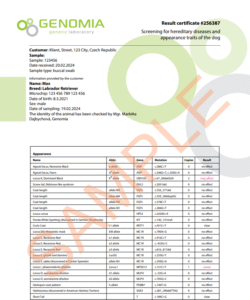
Testing performed in cooperation with our accredited partner laboratory.
Primary Lens Luxation (PLL) is an inherited eye disorder in dogs that causes the lens to detach from its normal position within the eye.
When the fibres of the suspensory apparatus weaken or break, the lens moves from its natural location into the anterior or posterior chamber. This can lead to:
– acute pain,
– glaucoma,
– and permanent loss of vision.
PLL was first described more than 75 years ago.
Breeds most commonly affected
Although the mutation can appear in many breeds, PLL has been strongly associated with terrier-type dogs, including:
– Jack Russell Terrier
– Miniature Bull Terrier
– Lancashire Heeler
– Tibetan Terrier
– Parson Russell Terrier
– Patterdale Terrier
– Rat Terrier
– Sealyham Terrier
– Toy Fox Terrier
– Volpino Italiano
– Welsh Terrier
– Chinese Crested
– Australian Cattle Dog
– Fox Terrier
– Yorkshire Terrier
– Jagdterrier
Genetic cause
PLL is linked to a splice donor site mutation in the ADAMTS17 gene.
The mutation (c.1473+1G>A) disrupts normal processing of the gene, affecting connective tissues throughout the body — not only the eye.
The ADAMTS family of genes plays important roles in:
– connective tissue development
– growth of organs
– joint, kidney, uterus and heart function
Mutations in ADAMTS genes can be associated with various conditions, such as:
– Ehlers–Danlos syndrome type VIIC
– Weill–Marchesani syndrome
– osteoarthritis
– thrombocytopenic purpura
– abnormal pigmentation
Clinical studies
A large study (Farias et al., 2010) analysed PLL status in 829 dogs from several breeds.
Out of 196 diagnosed PLL cases:
– 161 dogs were homozygous for the mutation (A/A)
– 23 dogs were carriers (A/G)
– 12 dogs were normal genotype (G/G)
Of the 633 dogs with normal clinical findings, 15 had the A/A genotype, all younger than 6 years old.
This indicates that PLL may develop later in life, especially after 10 years of age.
G/G genotype dogs
409 dogs in the study were G/G (clear).
Only 12 of them showed clinical signs of lens luxation, suggesting:
– alternative causes of PLL exist (e.g., different fibre weakness, zonular dysplasia)
– or a different mutation within the same gene region
These “alternative PLL” cases represent less than 3% of the affected population.
Frequency of genotypes in affected breeds
In PLL-affected Jack Russell Terriers:
– 2.5% A/G
– 21% G/G
– 76% A/A
In Lancashire Heelers:
– 29% A/G
– 8% G/G
– 63% A/A
In Miniature Bull Terriers:
– carriers: 14%
– clear: 7%
– affected (A/A): 79%
This shows that carriers (A/G) may also be at increased risk, depending on breed background.
Testing and interpretation
DNA testing identifies the presence or absence of the ADAMTS17 mutation.
Genotypes:
– G/G (Clear) – no mutation present
– A/G (Carrier) – carries one mutated allele; may or may not develop symptoms
– A/A (Affected/At-Risk) – two mutated alleles; strongly predisposed to PLL
Not all carriers develop clinical PLL, but approximately 2–20% of carriers show symptoms during their lifetime.
Regular veterinary eye examinations are recommended every 6–12 months for carriers and affected dogs.
Inheritance
PLL is inherited as an autosomal recessive disorder, but:
– Even carriers may sometimes develop symptoms.
– Affected dogs (A/A) have a very high risk of developing PLL.
– Carriers (A/G) may require lifelong monitoring.
Breeding recommendations
– G/G dogs are safe for breeding.
– A/G dogs should only be bred with G/G partners.
– A/A dogs should not be used for breeding.
The aim is to reduce the spread of the mutation while preserving genetic diversity within the breed.
—
References
Farias FH, Johnson GS, Taylor JF, et al. AJAMTS17 splice donor site mutation in dogs.
Gray H. Inherited ocular diseases in the dog.
Morales J. et al. Mutations in ADAMTS10 and ADAMTS17 genes associated with ocular disorders.
Cal S, Obaya AJ, et al. Characterisation of ADAMTS metalloproteinases.
Porter S, Clark IM. The ADAMTS metalloproteinase family.
David R. Sargan et al. Mapping the mutation causing PLL in terrier breeds.
Reviews
There are no reviews yet.