

A genetic profile (DNA profile) is a permanent set of DNA markers that uniquely identifies an individual. These markers never change, making the profile reliable for proving identity, confirming parentage, checking family relationships, and supporting breeding decisions.
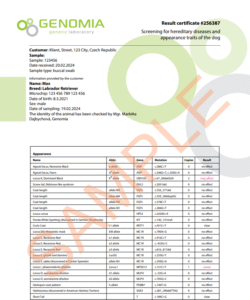
Genetic profile
A genetic profile, sometimes referred to as a DNA profile, is a set of genetic markers that allow an individual to be uniquely identified. A genetic marker is a specific part of the DNA code that varies between individuals.
A genetic profile is permanent throughout life, cannot be modified or destroyed, and serves as a reliable method to identify an individual, verify parentage and relationships, or support breeding decisions.
—
Genetic profiling possibilities
Genetic profiling serves as highly reliable, lifelong identification in many situations:
Identification
– In case of loss or theft of a dog – The identity of a recovered dog can be proven using the DNA profile.
– In case of a malfunctioning microchip – If the microchip fails, the dog’s identity can still be proven, allowing re-chipping.
– During insemination – Used to identify semen.
Parentage verification
– Routine pedigree checks or uncertainty about parentage – Confirms paternity or maternity after planned/accidental mating or insemination.
– Double mating cases – In breeds where double mating is allowed, DNA profiles of the mother, both sires, and all puppies are required so the laboratory can determine the correct father.
– “Clear by parents” verification – If both parents have tested negative for a specific recessive genetic disorder, their puppies may be declared “clear by parents,” provided parentage is proven by DNA profiling. Recommended to repeat in every second generation.
– Verification of other family relationships – If direct parentage cannot be verified, other relationships (siblings, grandparent–grandchild, uncle–nephew, etc.) can be analysed. The more related individuals included, the higher the accuracy.
Use in breeding
– Selecting the optimal breeding pair – Comparing genetic profiles helps choose mating pairs that maintain or increase genetic diversity. Pairs that are more heterozygous in compared markers are preferred.
– Population studies – Monitoring diversity, heterozygosity, and inbreeding levels.
—
Sample collection
For DNA testing, buccal swabs are used.
The sample must be collected carefully by rubbing the swab firmly against the inside of the dog’s cheek and allowing it to dry completely in a breathable container.
A properly collected and stored swab provides excellent DNA quality for all tests.
—
Methodology
At Perro Genetics, DNA profiling is performed in cooperation with our partner laboratory, which uses internationally recognised ISAG (International Society for Animal Genetics) standards.
In independent ISAG quality tests, the laboratory repeatedly achieves the highest quality rating.
DNA profiling is accredited according to ISO 17025, ensuring the highest level of competence for canine DNA analysis.
There are two main technological approaches to genetic profiling:
– STR
– SNP
These two systems are not compatible and cannot be compared directly.—
STR genetic profile (ISAG2006)
STR (Short Tandem Repeats) genetic profiling analyses microsatellite markers — short repetitive DNA sequences (2–7 base pairs).
The number of repeats is individual and inherited from each parent.
Because of this inheritance pattern, STR profiling is an excellent tool for parentage verification and individual identification.
STR analysis workflow
1. DNA isolation – Extracting DNA from the sample.
2. PCR amplification – STR markers are amplified using specific primers. One primer carries a fluorescent dye for detection.
3. Fragment separation via electrophoresis – Amplified DNA fragments are separated by size.
4. Laser detection and data analysis – Fluorescent signals are recorded to determine allele lengths.
5. Interpretation of results – Each individual receives one value from the father and one from the mother per marker. Parentage can be verified with >99.99% accuracy.
Markers included in the ISAG2006 panel
AHTk211, CXX279, REN169O18, INU055, REN54P11, INRA21, AHT137, REN169D01, AHTh260, AHTk253, INU005, INU030, Amelogenin, FH2848, AHT121, REN162C04, AHTh171, REN247M23, AHTH130, REN105L03, REN64E19.
The partner laboratory reports at least 19 markers.
—
SNP genetic profile (ISAG2020)
SNP (Single Nucleotide Polymorphism) profiling analyses single base-pair variants.
SNPs are highly stable, follow Mendelian inheritance, and provide excellent resolution for genetic identification and population studies.
Markers are evenly distributed across chromosomes, ensuring complete genome coverage.
SNP profiling uses advanced sequencing technologies, enabling high accuracy and high throughput.
SNP analysis workflow
1. DNA isolation – High-quality DNA is essential; blood is preferred.
2. Massively Parallel Sequencing (MPS/NGS) – Thousands of markers are sequenced simultaneously.
3. SNP detection – ISAG2020 Panels 1 and 2 standardise the analysis of 231 SNP markers. The partner laboratory reports a minimum of 218 markers.
4. Bioinformatics evaluation – Software identifies genotypes and determines SNP variants inherited from each parent.
Advantages of SNP profiling
– Higher accuracy — due to more markers across the entire genome.
– Greater marker stability — low mutation rate (1 per ~100 million bases per generation).
– High throughput — hundreds of samples analysed simultaneously.
– Ideal for population studies — inbreeding, diversity, heterozygosity.
Disadvantages
– Longer processing time.
—
ISAG membership and quality
Perro Genetics cooperates with a partner laboratory that is an active ISAG member, regularly participating in biannual ISAG comparative quality tests and consistently achieving Quality Rank 1.
Reviews
There are no reviews yet.