


MH is a life-threatening reaction that can occur under general anaesthesia. It’s caused by an RYR1 gene mutation (c.7489C>T), which disrupts calcium release in muscle cells. When exposed to certain anaesthetic agents, affected dogs can develop rapid temperature spikes, muscle rigidity, high CO₂ levels, fast heart rate, and collapse.
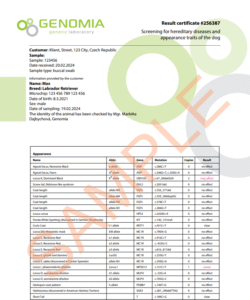
Testing performed in cooperation with our accredited partner laboratory.
Malignant Hyperthermia (MH) is a severe and potentially fatal complication that can occur during general anaesthesia.
It is a pharmacogenetic disease affecting skeletal muscles, characterised by:
– excessive muscle contraction
– hypercapnia (high CO₂ levels)
– tachycardia
– and dangerously elevated body temperature
The reaction occurs in response to certain triggering chemicals, primarily specific anaesthetic agents.
Dogs affected by MH typically show no clinical symptoms unless exposed to these triggers.
MH has been described in several species, including cats, dogs, horses, cattle, and rabbits.
Genetic cause
In dogs, MH is caused by a mutation in the RYR1 gene (ryanodine receptor 1).
This gene encodes a calcium-release channel in the sarcoplasmic reticulum of muscle cells.
The identified mutation is c.7489C>T (p.Val2497Ile).
When anaesthetic drugs trigger the defect, the calcium channel remains abnormally open, releasing excessive calcium into muscle cells.
This results in:
– uncontrolled muscle contraction
– increased oxygen consumption
– elevated CO₂ production
– acidosis
– severe heat generation
These changes can rapidly become life-threatening during anaesthesia.
Clinical signs
Affected dogs may experience:
– rapid rise in body temperature
– muscle rigidity
– increased heart rate
– respiratory distress
– collapse
If the anaesthetic is not interrupted, the signs progress quickly and can be fatal.
Genetics and inheritance
MH is inherited in an autosomal dominant manner.
This means:
– One copy of the mutation is enough to predispose a dog to MH.
– Dogs with one mutated allele (MH/N) are at risk.
– Dogs with two mutated alleles (MH/MH) are also at risk and may show more severe reactions.
– Genetically normal dogs (N/N) are not predisposed.
Animals with the mutation may live their entire lives without any clinical signs as long as they are not exposed to triggering anaesthetics.
If an affected dog is bred:
– The risk of passing the mutation to offspring is 50%.
Breeding considerations
Because MH is dominant, breeding animals should be screened to prevent passing the mutation to future generations.
Dogs carrying the mutation should not be used for breeding, especially in breeds where anaesthetic-related complications are already a concern.
References
Roberts, M.C. et al. Autosomal dominant canine malignant hyperthermia is caused by a mutation in the RYR1 gene.
Anesthesiology 95:716–725, 2001.
Brunson, D.B., Hogan, K.J.: Malignant hyperthermia: a syndrome, not a disease.
Veterin. Clin. North Am Small Anim Pract 34:1419–33, 2004.




Reviews
There are no reviews yet.